September 2026: Moving from Hopelessness to Hope: A future free of PFA ependymoma

Press Release
Ependymoma Research Foundation Advances New Strategies to Target EZHIP, a Key Driver of PFA Ependymoma
The Ependymoma Research Foundation (ERF) is at the forefront of a advancing a focused research effort aimed at one of the most promising therapeutic targets identified in PFA ependymoma: EZHIP. Through a series of highly targeted research investments since 2018, the Foundation has helped move EZHIP from an important biological discovery toward potential therapeutic strategies designed to directly eliminate or suppress this critical protein moving towards our goal of identifying a viable drug within 10 years of our inception.
PFA ependymoma remains one of the most difficult pediatric brain tumors to treat. Surgery and radiation can provide meaningful control for some patients, but there remains no highly effective systemic therapy for children with residual, recurrent, or progressive disease. EZHIP has emerged as a particularly compelling target because of its central role in the molecular biology of PFA tumors. Research has shown that EZHIP disrupts normal regulation of the PRC2 complex and H3K27me3, while also contributing to the abnormal three-dimensional organization of the PFA genome. These findings suggest that PFA tumors may be unusually dependent on continued EZHIP activity.
The ERF is now supporting two complementary approaches to targeting EZHIP. One approach seeks to eliminate the EZHIP protein itself through targeted protein degradation. Research led by Jun Qi, PhD, Mariella Filbin, MD, PhD and Mohammed Movassaghi, PhD, collaborators at Dana-Farber Cancer Institute and MIT, has identified Verticillin A and related compounds as promising EZHIP-targeting molecules. Recent work demonstrated that these compounds can interact with EZHIP and alter the abnormal epigenetic program associated with the protein. ERF has provided additional funding to accelerate this research and identify compounds with improved activity and therapeutic potential.
A second approach, being pursued by Marco Gallo, PhD, and his laboratory, uses antisense oligonucleotides (ASOs) to prevent PFA tumor cells from producing EZHIP in the first place. This research has already produced preliminary EZHIP-targeting compounds and an animal-based PFA tumor model in which these agents can be evaluated. This represents an important step toward determining whether EZHIP suppression can translate into meaningful tumor control in vivo.
Together, these projects represent a significant evolution in ERF's research strategy. Rather than pursuing unrelated therapeutic approaches, the Foundation is concentrating resources on a specific molecular vulnerability and attacking it from two different directions: destroying EZHIP after it is produced and preventing the tumor from producing EZHIP at all. The Foundation is also exploring whether these approaches could ultimately be used together. "EZHIP has become one of the most compelling potential therapeutic targets in PFA ependymoma," said Dr. Jeff Clayman, Scientific lead of the ERF. He went on to describe, "Our goal is to move this research beyond understanding why EZHIP matters and toward determining whether we can actually use that vulnerability to treat children with PFA." With the foundation's help, more progress has been made toward finding a cure for PFA ependymona in the past five years than in previous 100.
The research remains preclinical, and substantial work is still required before any EZHIP-targeted treatment could be tested in patients. However, given the pace of progress, it is likely that a clinical trial is now on the near horizon and no longer an abstract concept. The next critical milestones include demonstrating efficacy in PFA tumor models, establishing that compounds can reach tumors in the brain, determining appropriate dosing and toxicity, and identifying the most effective and selective EZHIP-targeting agents.
Nevertheless, the progress represents an important milestone for the field. ERF's investment is helping build a potential therapeutic pipeline around EZHIP—from basic biology and target validation to drug discovery, antisense technology, and animal testing. The Foundation remains committed to supporting this work as it advances toward the ultimate goal: developing effective treatments for children with PFA ependymoma.
If you, or anyone close to you has been impacted by PFA ependymoma, consider a donation to the Ependymoma Research Foundation.
Link to recent article from funded research:Link to article.
Based on our current review of published literature, the foundation believes that EZHIP provides the clearest possible drug target for PFA ependymoma and further projects in this area are currently being considered. Please check back periodically for updates.
September 2026: Current Research Rationale
Current Research Goals and rationale for funding.
There is currently no highly effective chemotherapeutic agent for the treatment of Posterior Fossa Type A (PFA) Ependymoma. The current standard of care treatment which includes surgery and radiation of various forms is often ineffective in completely removing and treating tumor with frequent recurrences after treatment is completed. There is a strong need for a chemotherapeutic agent that could be utilized after surgery to treat residual tumor that cannot be resected and cannot be effectively radiated due to close proximity to delicate brainstem structures. Such a therapy should be able to cross the blood brain barrier, ideally be orally administered and precisely target the PFA Ependymoma cells as well as be well tolerated and not cause severe collateral damage to other organs.
In the past several years, there has been a tremendous amount of clinical interest in a protein called EZH2 inhibitory protein (EZHIP) which appears to be central to the propagation and growth of PFA Ependymoma. EZHIP is a protein that interacts with another protein call EZH2 (Enhancer of Zeste Homolog 2) which is a core component of a third protein call Polycomb Repressive Complex 2 (PRC2) which regulates gene expression by methylation of the DNA Histone H3 on lysine 27 (H3K27me3). Histones are proteins which regulate the expression and folding of DNA. A more recent study by Gallo, et al, further defined the mechanism of action of EZHIP by postulating a role for EZHIP in the formation of type B ultra long-range interactions in PFAs (TULIPS) which regulate the 3 dimensional folding of DNA allowing distant portions of DNA to interact allowing the growth of PFA Ependymoma. Without these long range interactions, PFA ependymoma cells cannot propagate and grow.
Based on this recently published data, EZHIP appears to play a central role in the propagation and growth of PFA Ependymoma. What makes EZHIP a truly remarkable drug target is that this protein appears to primarily function normally in the early phases of embryonal development and is then repressed later in development. PFA ependymoma is a tumor that is locked in an early developmental state with continual output of the EZHIP protein.
The Ependymoma Research foundation (ERF) is currently focusing its funding efforts on research related to the EZHIP and finding ways to potentially block this protein. Strategies under consideration for funding utilize techniques such as protein degradation, whereby the body’s own mechanisms of protein degradation are used to try and preferentially degrade EZHIP and interference RNA, where the process of production of EZHIP could potentially be impeded.
The ependymoma research foundation views both of these strategies as potential treatments for ependymoma on their own with likely improved effectiveness should they be utilized together. The ERF is currently in the process of identifying projects in these two areas with two $50,000 research grants. Based on the preliminary work from recently funded projects, we anticipate the need for additional funds beyond the two projects that are already funded in the same area.
Currently, there is no highly effective chemotherapeutic agent for treating Posterior Fossa Type A (PFA) Ependymoma. The standard treatment includes surgery and various forms of radiation, which often fail to completely remove or treat the tumor. There is a critical need for a chemotherapeutic agent that can be used post-surgery to target residual tumors that cannot be resected or effectively radiated due to their proximity to delicate brainstem structures. Such a therapy should cross the blood-brain barrier, ideally be orally administered, precisely target PFA Ependymoma cells, and be well tolerated without causing severe damage to other organs. In recent years, there has been significant clinical interest in a protein called EZH2 inhibitory protein (EZHIP), which appears central to the growth and propagation of PFA Ependymoma. EZHIP interacts with EZH2 (Enhancer of Zeste Homolog 2), a core component of Polycomb Repressive Complex 2 (PRC2), which regulates gene expression by methylating Histone H3 on lysine 27 (H3K27me3). A recent study by Gallo et al. further elucidated the role of EZHIP in forming type B ultra-long-range interactions in PFAs (TULIPS), which regulate the three-dimensional folding of DNA, facilitating PFA Ependymoma growth.
EZHIP is a compelling drug target because it primarily functions in the early phases of embryonal development and is repressed later in development. PFA Ependymoma is a tumor locked in an early developmental state with continual production of the EZHIP protein. The Ependymoma Research Foundation (ERF) is focusing its funding efforts on research related to EZHIP, seeking ways to block this protein. Strategies under consideration include protein degradation, using the body's own mechanisms to preferentially degrade EZHIP, and interference RNA, which could impede EZHIP production.
The ERF views both strategies as potential treatments for ependymoma, with likely improved effectiveness if used together. The foundation is currently identifying projects in these areas, offering two $50,000 research grants. Based on preliminary work from recent projects, additional funding beyond these two projects will likely be needed.
Link to recent article from funded research:Link to article.
Based on our current review of published literature, the foundation believes that EZHIP provides the clearest possible drug target for PFA ependymoma and further projects in this area are currently being considered. Please check back periodically for updates.
September 2026: The Ependymoma Research Foundation will be attending the Genesis Battlegreen Run.

Come run (or walk) with us. We will be raising funds for the Ependymoma Research Foundation on Sunday, November 1, 2026 at the Genesis Battlegreen Run, in Lexington, MA.
When: November 01, 2026, 12:15 PM
Where: Lexington High School Field house: 251 Waltham St., Lexington, MA 02420
EVENT DETAILS:
The Annual Genesis Battlegreen Run/Walk
JOIN OUR TEAM, Ependymoma Research Foundation!
We are participating in this race to raise money for a cure to ependymoma for a directed research project at Dana Farber Cancer Institute (SEE BELOW). All funds collected will be directly applied to the project.
Sign up here: Sign up for the 2026 Battlegreen Run
When you get to the team selection page make sure you choose "Ependymoma Research Foundation" as your team.
July 2026: Funding Award Updates
The Ependymoma Research Foundation has received updates from both the Gallo lab related to recent project funding. The Gallo lab is investigating the use of anti sense oligonucleotides as a method of targeting EZHIP and some preliminary compounds have been developed. With the funding, the lab has also developed an animal based tumor model system to test these agents. Research is ongoing.
Based on our current review of published literature, the foundation believes that EZHIP provides the clearest possible drug target for PFA ependymoma and further projects in this area are currently being considered. Please check back periodically for updates.
MAY 2026: Funding Award Updates
The Ependymoma Research Foundation has provided an additional $50,000 in direct funding to the laboratory of Jun Qi, PhD, at Dana-Farber Cancer Institute to advance his investigation of protein degradation as a strategy for targeting EZHIP, a critical protein dependency of PFA ependymoma. Additional funding was provided following the December 2025 publication of “Total Synthesis and Anticancer Study of (+)-Verticillin A.” This collaborative study identified the naturally occurring antifungal metabolite Verticillin A as a potential EZHIP-targeting compound. Using a thermal shift assay, the investigators demonstrated binding between Verticillin A and EZHIP and provided evidence that treatment with Verticillin A can reverse the epigenetic effects associated with EZHIP, including the loss of the repressive histone mark H3K27me3. These findings represent a potentially important advance toward the development of a targeted, mechanistically driven therapy for PFA ependymoma. In particular, they provide evidence that directly targeting the EZHIP protein—and potentially eliminating it through targeted protein degradation—may be a viable therapeutic strategy. Verticillin A is part of a larger family of structurally related compounds. Members of this family will be evaluated to identify compounds with improved EZHIP binding, activity, selectivity, and therapeutic potential. The study represents an important collaboration between the laboratory of Dr. Mohammad Movassaghi at the Massachusetts Institute of Technology, which conducted the synthetic chemistry and compound-development work, and Dr. Mariella Filbin, MD, PhD, at Dana-Farber Cancer Institute, who provided clinical and biological expertise. The Ependymoma Research Foundation is committed to supporting this work as it progresses. With continued positive results, the Foundation anticipates providing ongoing longitudinal support for this project with the goal of advancing EZHIP-targeted approaches from laboratory discovery toward a potential treatment for children with PFA ependymoma.
Link to article:Link to article.
Based on our current review of published literature, the foundation believes that EZHIP provides the clearest possible drug target for PFA ependymoma and further projects in this area are currently being considered. Please check back periodically for updates.
May 2026: The Ependymoma Research Foundation will be attending the Genesis Battlegreen Run.
Come run (or walk) with us. We will be raising funds for the Ependymoma Research Foundation on Sunday, November 2, 2025 at the Genesis Battlegreen Run, in Lexington, MA.
When: November 03, 2025, 12:15 PM
Where: Lexington High School Field house: 251 Waltham St., Lexington, MA 02420
EVENT DETAILS:
The 25th Annual Genesis Battlegreen Run/Walk is Sunday, November 2th, 2025 at 12:15 PM
JOIN OUR TEAM, Ependymoma Research Foundation!
We are participating in this race to raise money for a cure to ependymoma for a directed research project at Dana Farber Cancer Institute (SEE BELOW). All funds collected will be directly applied to the project.
Sign up here: Sign up for the 2025 Battlegreen Run
When you get to the team selection page make sure you choose "Ependymoma Research Foundation" as your team.
MAY 2025: Funding Award Updates
The Ependymoma Research Foundation has funded $50,000 total in direct funding to the lab of Marco Gallo, PHD at Baylor College of Medicine to investigate the transcriptional heterogeneity of EZHIP. Multiple recent peer reviewed articles have identified EZHIP as a possible drug target for the treatment of many types of PFA ependymoma and this study will further our understanding of the possible effectiveness of a drug specifically targeted at this molecule. The foundation wants to thank the Barrell Family specifically for taking the lead in fundraising for this project.
Based on our current review of published literature, the foundation believes that EZHIP provides the clearest possible drug target for PFA ependymoma and further projects in this area are currently being considered. Please check back periodically for updates.
November 2024: Funding Award Updates
The Ependymoma Research Foundation has funded $100,000 total in direct funding to the labs of Jun Qi, PHD and Mariella Filbin, MD at Dana Farber Cancer institute to investigate the use of protein degradation as a method to target a protein closely associated with PFA ependymoma called EZHIP. Multiple recent peer reviewed articles have identified EZHIP as a possible drug target for the treatment of many types of PFA ependymoma and protein degradation may provide a long sought after targeted therapy. It is anticipated that additional funding will be required for this project and the Ependymoma Research Foundation has started a new fundraising campaign to provide additional funding for this project over the next 12 months. The foundation wants to specifically thank the Lesko family for spearheading much of the funding for this project.
September 2024: The Ependymoma Research Foundation will be attending the Genesis Battlegreen Run.
Come run (or walk) with us. We will be raising funds for the Ependymoma Research Foundation on Sunday, November 3, 2024 at the Genesis Battlegreen Run, in Lexington, MA.
When: November 03, 2024, 12:15 PM
Where: Lexington High School Field house: 251 Waltham St., Lexington, MA 02420
EVENT DETAILS:
The 25th Annual Genesis Battlegreen Run/Walk is Sunday, November 3th, 2024 at 12:15 PM
JOIN OUR TEAM, Ependymoma Research Foundation!
We are participating in this race to raise money for a cure to ependymoma for a directed research project at Dana Farber Cancer Institute (SEE BELOW). All funds collected will be directly applied to the project.
Sign up here: Sign up for the 2024 Battlegreen Run
When you get to the team selection page make sure you choose "Ependymoma Research Foundation" as your team.
September 2023: The Ependymoma Research Foundation will be attending the Genesis Battlegreen Run.
Come run (or walk) with us. We will be raising funds for the Ependymoma Research Foundation on Sunday, November 5, 2023 at the Genesis Battlegreen Run, in Lexington, MA.
When: November 05, 2023, 12:15 PM
Where: Lexington High School Field house: 251 Waltham St., Lexington, MA 02420
EVENT DETAILS:
The 25th Annual Genesis Battlegreen Run/Walk is Sunday, November 5th, 2023 at 12:15 PM
JOIN OUR TEAM, Ependymoma Research Foundation!
We are participating in this race to raise money for a cure to ependymoma for a directed research project at Dana Farber Cancer Institute (SEE BELOW). All funds collected will be directly applied to the project.
Sign up here: Sign up for the 2023 Battlegreen Run
When you get to the team selection page make sure you choose "Ependymoma Research Foundation" as your team.
May 2023:
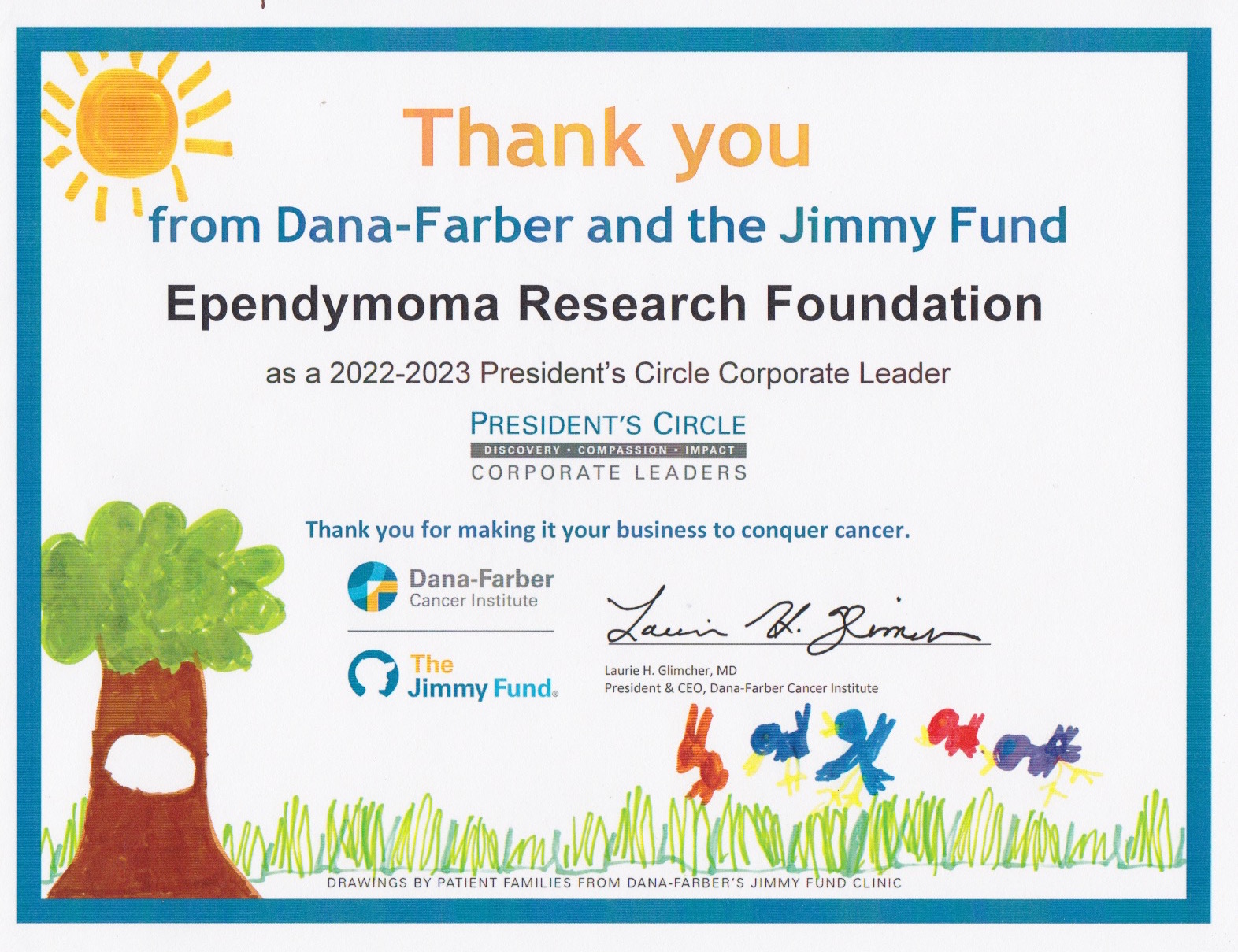
The Ependymoma Research Foundation funded $50,000 of a $100,000 project to investigate the use of protein degradation technology targeted toward the novel protein EZHIP. The work will be conducted through the lab of Mariella Filbin, MD and Jun Qi, PhD at Dana Farber Cancer Institute on Boston. This novel technology may yield a long sought after targeted therapy for PFA ependymoma.
April 2023:
Dr. Jeffrey Clayman, President of the Ependymoma Research Foundation was recently invited to the Boston University School of Communication to speak about the foundation, the current state of research into Ependymoma and our plans for funding. You can view the video here.
September 2022: The foundation was recently featured by local news channel WCVB by reporter Erica Tarantal.
September 2022: The Ependymoma Research Foundation will be attending the Genesis Battlegreen Run.
Come run (or walk) with us. We will be raising funds for the Ependymoma Research Foundation on Sunday, November 6, 2022 at the Genesis Battlegreen Run, in Lexington, MA.
When: November 06, 2022, 12:15 PM
Where: Lexington High School Field house: 251 Waltham St., Lexington, MA 02420
EVENT DETAILS:
The 25th Annual Genesis Battlegreen Run/Walk is Sunday, November 6th, 2022 at 12:15 PM
JOIN OUR TEAM, Ependymoma Research Foundation!
We are participating in this race to raise money for a cure to ependymoma for a directed research project at Dana Farber Cancer Institute (SEE BELOW). All funds collected will be directly applied to the project.
Sign up here: Sign up for the 2022 Battlegreen Run
When you get to the team selection page make sure you choose "Ependymoma Research Foundation."
June 2022:
The Ependymoma Research Foundation has decided to move forward with funding of a $100,000 project to investigate the use of protein degradation technology targeted toward the novel protein EZHIP. The work will be conducted through the lab of Mariella Filbin, MD at Dana Farber Cancer Institute on Boston. This novel technology may yield a long sought after targeted therapy for PFA ependymoma. We are currently fundraising for this project are currently at 30% of out goal. Please contact us if you are interested in contributing.
April 2022:
The Ependymoma Research Foundation has received some preliminary findings from the Taylor Lab regarding a project funded through StopHersentumor.nl in March of 2021. The funded project was to investigate the use of perflurocarbon nanoparticles (PFC) to deliver a high oxygen concentration to an Posterior Fossa A Ependymoma Tumor Bed to determine if the known insensitivity of Ependymoma to a high oxygen environment could be translated into a therapy. With the funding received, initial experiments have been completed to determine the stability of PFC particles on a culture system and a system has been developed to reproducibly deliver nano particles into an animal model. Please check back for updates.
November 2021:
The Ependymoma Research Foundation has funded USD $50,000 to the lab of Mariella Filbin, MD, PHD and Bernhard Englinger, PHD, to complete a translational project related to the use of fibroblast growth factor inhibitors as a treatment for posterior fossa type A ependymoma (PFA) in a mouse model. Recent work in Dr. Filbin and Englinger's lab has revealed that fibroblast growth factor receptors 1 and 3 are over expressed in ependymoma and that they are both critical for PFA stemness and inhibition inhibits growth in in vitro models. This in vivo experiment will particularly focus on PFA in a mouse model to examine the ability of these drugs to cross the blood brain barrier and to assess their overall effectiveness to inform a future human trial of this class of medications.
October 2021: The Ependymoma Research Foundation will be attending the Genesis Battlegreen Run.
Come run (or walk) with us. We will be raising funds for the Ependymoma Research Foundation Sunday, November 3, at the Genesis Battlegreen Run, in Lexington, MA.
When: November 07, 2021, 12:15 PM
Where: Lexington High School Fieldhouse: 251 Waltham St
EVENT DETAILS:
The 25th Annual Genesis Battlegreen Run/Walk is Sunday, November 7th!
JOIN OUR TEAM, Ependymoma Research Foundation!
We are participating in this race to raise money for a cure to ependymoma.
Sign up here: Sign up for the 2021 Battlegreen Run
When you get to the team selection page make sure you choose "The Ependymoma Research Foundation."
After you complete your registration you can begin to fundraise for our team. Please use and share the following link: Fundraising Link! https://charity.gofundme.com/o/en/campaign/ependymoma-foundation1/battlegreen-run-foundation-inc?modified=1
April 2021: This Saturday, April 10th is #nationalsiblingsday and to celebrate we will be hosting an online book reading with our co-founder Samarrah Fine Clayman! We will be partnering with the Ronald McDonald House Charities (RMHC) and Christopher's Haven ! Join us with your family to read the book! Register Here
April 2021: The Ependymoma Research Foundation is beginning a new funding cycle and will shortly be sending out new invitation only requests for research proposals offering $55,000 USD of support.
The successful applicant would present a project to us that would build on the existing database of knowledge leading toward a cure for PFA and PFB ependymoma which could be deployed quickly to allow an improvement in the current standard of care and be life extending or curative. We are most interested in high risk projects which would otherwise not be funded by traditional funding mechanisms which could rapidly propel treatment forward.
To apply, we require a two page (maximum 500 words) memorandum outlining a specific project related to the above research (with supporting references) and how the funds would be applied. The deadline for the application is currently 4/20/21. Funds will be made available to the successful application at latest 6/15/21. Please either mail or email your proposal to jclayman10@gmail.com in .pdf form. We will then review that application and contact you with any questions that our foundation members and partners may have.
March 2021: The Ependymoma Research Foundation has completed its first funding project. Between August and December of 2020, The scientific committee of the Ependymoma research foundation led by Dr. Jeffrey Clayman, solicited proposals for research based on recent research and brokered financing from private citizen Sanne Deurvorst in the Netherlands and the Dutch tumor foundation, STOPHersentumor.nl to provide $97,596.17 CAD for the Michael Taylor Lab in Toronto, Canada. All proposals underwent rigorous review by the Ependymoma Research Foundation and the review board of STOPHersentumor.nl before selection of the winner. The sponsored research is related to recent research suggesting that PFA Ependymoma is dependent on hypoxic conditions for growth. The research will investigate the use of high oxygen affinity perflurocarbon compounds as a medium to impede growth of PFA Ependymoma (and possibly other tumors) in a live mouse model. The hope is that that these compounds could potentially be used to manipulate the microenvironment of PFA Ependymoma to impede or stop growth. Progress related to this project will be periodically reported here.
September 2020: The Ependymoma Research Foundation will be attending the 2020 Genesis Battlegreen Run. Come run (or walk) with us virtually! We will be raising funds for the Ependymoma Research Foundation Sunday, November 1, 2020 at the Genesis Battlegreen Run, in Lexington, MA. You can sign up through the Battlegreen Run Foundation, Inc. and choose team, "Ependymoma Research Fdn." - https://battlegreenrunfoundation.org Or if you rather support the cause without leaving home, you can donate using the link: https://www.crowdrise.com/o/en/campaign/ependymoma-research-foundation
August 2020: The Ependymoma Research Foundation has joined forces with the STOPBrainTumor foundation of the Netherlands and Sanne Deurvorst, also of the Netherlands, to offer $75,000 total in funding for directed brain tumor research to aid in finding a cure for posterior fossa ependymoma Type A/B. The application for the funds is by invitation only.
The successful applicant would present a project to us that would build on the existing database of knowledge leading toward a cure for PFA and PFB ependymoma which could be deployed quickly to allow an improvement in the current standard of care and be life extending or curative. We are most interested in high risk projects which would otherwise not be funded by traditional funding mechanisms which could rapidly propel treatment forward.
To apply, we require a two page (maximum 500 words) memorandum outlining a specific project related to the above research (with supporting references) and how the funds would be applied. The deadline for the application is currently 10/15/20. Funds will be made available to the successful application at latest 12/1/20. Please either mail or email your proposal to jclayman@massmed.org in .pdf form. We will then review that application and contact you with any questions that our foundation members and partners may have.
April 2020: Samarrah Clayman's book has attracted additional media attention from the National Association of Social Workers and the Lexington Colonial Times.
January 2020: The Collaborative Ependymoma Research Network, also known as CERN, has published on online article about Samarrah Clayman and her recently published book, "Will Jax be Home for Thanksgiving." You can find a link to their website here: CERN LINK
December 2020: The first shipment of "Will Jax be Home for Thanksgiving" has arrived! This groundbreaking children's book fulfills an urgent need for a book for young children who are afflicted with pediatric brain cancer to understand their disease and treatment. Books are available here: Order Now. All proceeds from the sale of the book will be applied toward our goal of finding a definitive, side effect and inexpensive cure for ependymoma. Consider buying your book and sending a donation today.
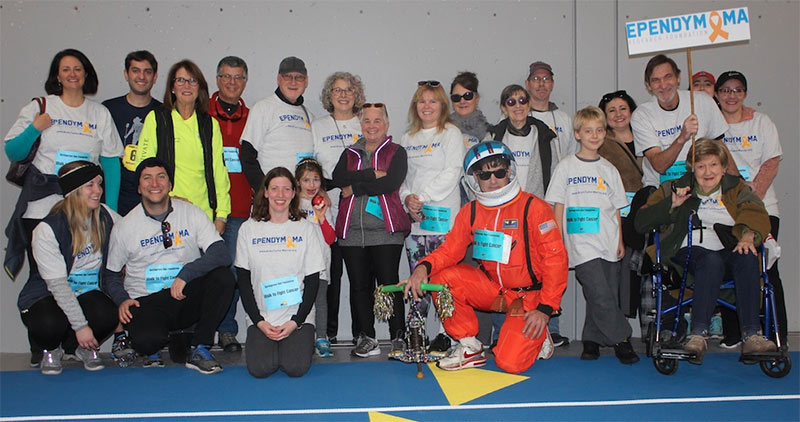
November 2019: The Battle Green Run was a great success for the Ependymoma Research Foundation. 42 walkers/runners from all walks of life showed up for a morning of exercise and food. We do not yet have a final tally of the total amount raised, but will post the amount when we can confirm it. Thank you everyone for making the effort. Your fundraising will make an impact on funding research to end Ependymoma. We are planning on participating again next year.
October 2019: Krystal Leon has published a self care article by Samarrah Clayman for the parents of ill children on "A Sailor's Wife Blog."
October 2019: You can also find a book review by Pamela Brunskill of Samarrah Clayman's "Will Jax be Home for Thanksgiving?" here.
October 2019: The Ependymoma Research Foundation will be attending the Genesis Battlegreen Run.
Come run (or walk) with us. We will be raising funds for the Ependymoma Research Foundation Sunday, November 3, at the Genesis Battlegreen Run, in Lexington, MA.
You can sign up through the Battlegreen Run Foundation, Inc. and choose team, "Ependymoma Research Fdn." - https://battlegreenrunfoundation.org
Or if you rather support the cause without leaving home, you can donate using the link: https://www.crowdrise.com/o/en/campaign/ependymoma-research-foundation
September 2019: Samarrah Clayman has released a preliminary cover for her upcoming book "Will Jax be Home for Thanksgiving?" which is to be published this Fall. The art was created by Amy Preveza. The book deals specifically with how a child and sibling deal with a a brain tumor diagnosis highlighting hope and love. A truly uplifting tale! The book will only be available through the Ependymoma Research Foundation website for a minumum $25 donation. All proceeds from this donation will be directed toward a currently funding project which you can read about here.
August 2019: Samarrah Clayman has agreed to donate all proceeds of her upcoming children's book to the Ependymoma Research Foundation. The book is specifically written and designed to help children and their siblings cope with pediatric cancer. The book is entitled, "Will Jax be Home for Thanksgiving?" An early sketch (c) from the book, drawn by acclaimed artist Amy Preveza, is posted below. The book is expected to be available directly through the Ependymoma Research Foundation Website by November 2019.
*Copyrighted Image, Amy Prevaza, 2019
July 2019: The Ependymoma Research Foundation has been approved as a recognized charity by the Attorney General's Office, State of Massachusetts.
April 2019: The Ependymoma Research Foundation has acquired 501(c)3 status with the IRS.
Available Now!
 All profits from the purchase of the book will be directed to pediatric brain tumor research.